Recordkeeping
Do I Need QuickBooks - or Just Better Business Records?
Compare full accounting software with focused recordkeeping and decide what your Canadian small business actually needs.
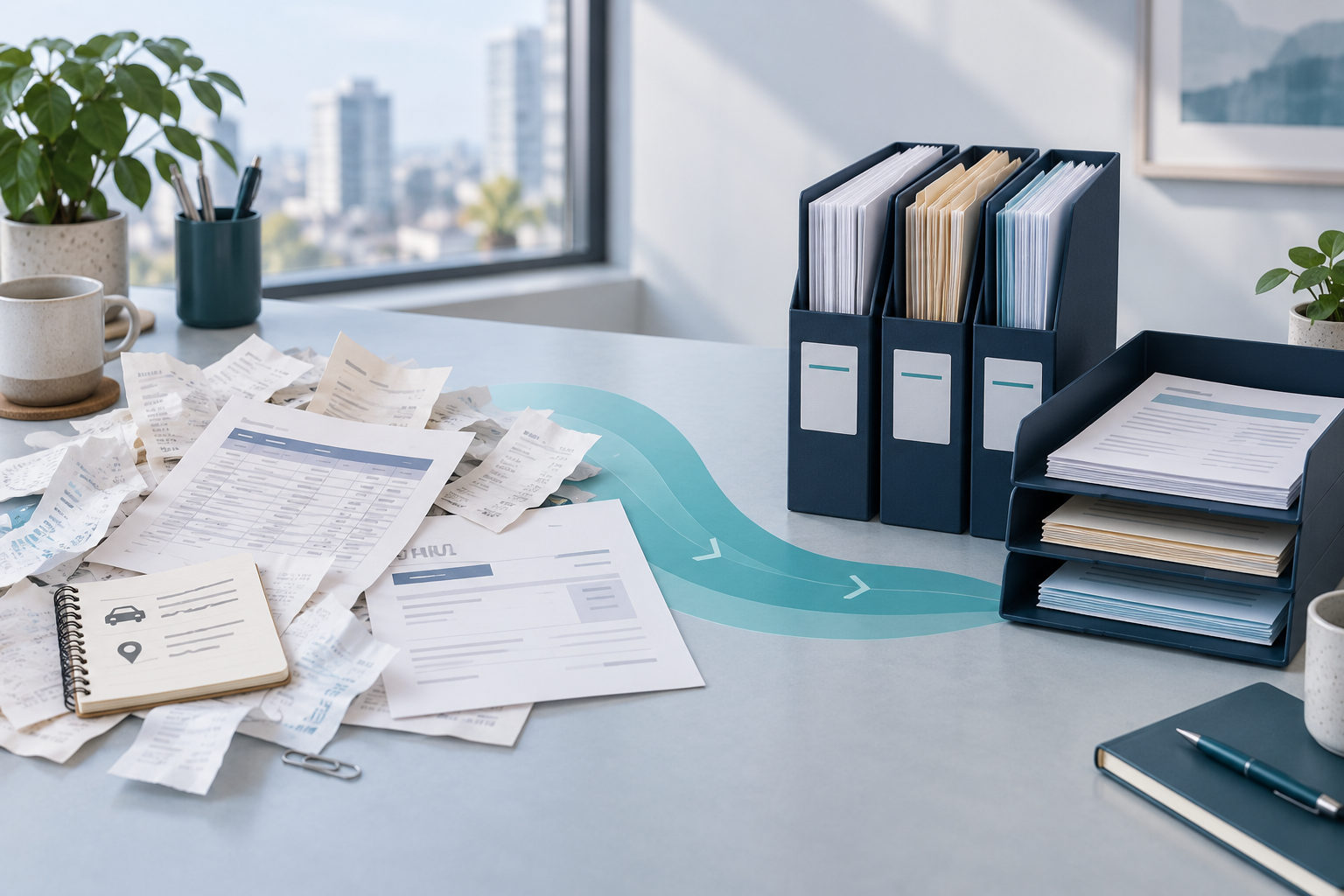
Running a business does not automatically mean you need every financial task inside one accounting platform.
Some owners need a general ledger, payroll, connected bank feeds, payment processing and detailed accounting reports. Others mainly need a reliable way to capture receipts, organize expenses, record mileage, keep different businesses separated and prepare complete records for an accountant.
Those are different jobs.
Before choosing software, identify the work you actually need it to perform. The right answer may be full accounting software. It may be a focused recordkeeping system. It may also be a combination: organized source records for the owner and professional accounting tools for the accountant.
Start with the job, not the product category
Many owners begin by asking, “Which accounting software should I buy?” A more useful question is:
What financial work must I complete reliably every week and every month?
Your answer might include:
- capturing receipts before they disappear;
- recording what was purchased and which Business it belongs to;
- distinguishing Business purchases from personal purchases;
- tracking money an owner paid personally and may need to be repaid;
- recording trips, mileage and fuel evidence;
- keeping customer and contractor invoices organized;
- finding missing information before month-end; and
- exporting clear records for professional review.
These are recordkeeping jobs. They support accounting, but they are not the same as maintaining a complete general ledger or filing a tax return.
When full accounting software is probably the better fit
Full accounting software may be appropriate when your business needs the software itself to manage:
- double-entry bookkeeping and a chart of accounts;
- formal financial statements;
- payroll processing and remittances;
- sales-tax filing workflows;
- inventory accounting;
- bank-feed reconciliation as the central workflow;
- customer payment processing; or
- complex accountant-managed adjustments.
QuickBooks and other accounting platforms are built to cover many of these functions. That breadth can be valuable when the business needs it and has someone who understands the resulting workflow.
SilaTrail does not replace a general ledger, payroll system, tax-filing service or accountant. It is designed for a narrower job: helping owners keep everyday business evidence complete, separated, reviewable and ready to hand off.
When focused recordkeeping may be enough
A focused recordkeeping system may be a better starting point when the main difficulty is not producing financial statements. It is maintaining trustworthy source records.
You may recognize the pattern:
- Receipts are divided between a wallet, vehicle, email inbox and phone.
- Expenses are recorded in a spreadsheet, but the supporting proof is somewhere else.
- One personal card pays for purchases across several Businesses.
- Mileage is reconstructed long after the trips occurred.
- An accountant asks questions that require searching through old messages and files.
- Month-end becomes a recovery exercise rather than a review.
In that situation, adding more automation does not necessarily solve the underlying problem. The owner first needs a dependable record trail.
Automation should prepare the work - not decide behind your back
Receipt reading can save time, but extracted information should be treated as a draft.
A scanner may misread a total, date, supplier or tax amount. A categorization suggestion may not reflect why the purchase was made. Even a technically accurate amount can be assigned to the wrong Business.
A reviewable workflow keeps the owner in control:
1. Capture the original receipt.
2. Let the software suggest what it can read.
3. Confirm or correct the important details.
4. Choose the correct Business and payment method.
5. Save the record with its source proof attached.
SilaTrail follows this approach. Automation assists with entry; the owner confirms the record before relying on it.
One owner can still need strict Business separation
Owning several Businesses does not make their records interchangeable.
Each receipt, expense, trip, invoice and contractor record should remain associated with the Business that owns the activity. Personal-card purchases may also need to be identified clearly so the Business can distinguish an owner-paid expense from a purchase made with Business funds.
A useful multi-Business workflow should let an owner:
- switch between distinct Business workspaces;
- see which Business is currently active;
- prevent records from silently appearing in another Business;
- track owner-paid purchases and repayments; and
- prepare exports for each Business independently.
This separation is a core part of SilaTrail rather than an afterthought added to a single-company spreadsheet.
Your accountant needs evidence, not just totals
A total in a spreadsheet may be useful, but it rarely answers every review question.
An accountant may also need to understand:
- what was purchased;
- when it was purchased;
- which Business used it;
- how it was paid;
- whether the owner paid personally;
- whether a receipt or invoice supports it; and
- whether the owner has already reviewed missing information.
Good recordkeeping connects the number to its context and source proof. It does not make the final accounting or tax decision. That boundary protects both the owner and the professional reviewing the records.
Four questions to decide what you need
1. Who will perform the accounting work?
If you or an internal bookkeeper will maintain a complete ledger, full accounting software may be central. If an external accountant will review and account for the activity, your immediate need may be better source records and a cleaner handoff.
2. Which features do you genuinely use?
List the workflows used every month. Separate them from features that sound useful but remain untouched. Paying for breadth does not create value if it adds complexity to the jobs you perform most often.
3. Do you need software to move money?
Recordkeeping and payment processing are different services. Decide whether the same provider needs to hold or process customer payments, or whether you simply need to record invoice and payment status.
SilaTrail records operational information; it does not hold customer payments.
4. Can you leave with usable records?
Before adopting any financial product, understand:
- what can be exported;
- whether source documents remain available;
- what happens after cancellation;
- how long records are retained; and
- which formats another person can open without the original software.
Portability should be evaluated before you need it.
A practical middle path
Choosing focused recordkeeping does not mean avoiding professional accounting.
A practical workflow can look like this:
1. The owner captures and reviews everyday records in SilaTrail.
2. Each Business remains in its own workspace.
3. Missing documents and uncertain items are identified during Monthly Review.
4. The owner exports organized records and source evidence.
5. An accountant applies professional judgment in the appropriate accounting or tax system.
This keeps the owner close to the evidence without asking recordkeeping software to make decisions outside its role.
The short answer
Choose full accounting software when you need the software to maintain the books, run accounting workflows or provide services such as payroll and payment processing.
Choose focused recordkeeping when the harder problem is keeping receipts, expenses, mileage, invoices and owner-paid purchases complete, separated and ready for review.
For many owner-operated Businesses, the question is not whether QuickBooks is good or bad. It is whether an all-in-one accounting platform matches the job that needs to be done.
SilaTrail is built for Canadian owners who want a clearer record trail without asking software to replace their accountant.
Start with your next receipt. No credit card and no automatic charge after the 14-day trial.
Editorial note
QuickBooks is a trademark of its respective owner. Product capabilities, regional availability and commercial terms can change. Confirm current information with the provider before making a purchasing or migration decision. This article provides general record-organization information, not accounting, tax or legal advice.